



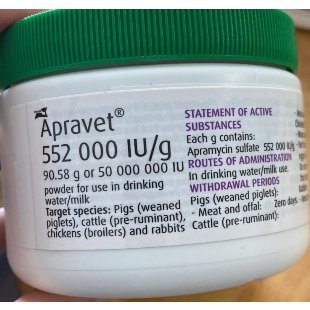
Apravet 552 IU/mg powder 90.58 gram, POM-V
Product Description
Apravet 552 IU/mg powder 90.58 gram
Target species
Pigs (weaned piglets), cattle (pre-ruminant), chickens (broilers) and rabbits.
Indications for use for each target species
Pigs (weaned piglets): Treatment of bacterial enteritis caused by Escherichia coli susceptible to apramycin.
Cattle (pre-ruminant): Treatment of bacterial enteritis caused by Escherichia coli and clinical outbreaks due to Salmonella enterica subsp. enterica serovar Dublin (Salmonella Dublin) susceptible to apramycin. Treatment should be based on prior confirmation of the Salmonella serovars involved or at least the availability of epidemiological data confirming the presence of this serovar.
Chickens (broilers): Treatment of colibacillosis caused by Escherichia coli susceptible to apramycin.
Rabbits: Treatment and metaphylaxis of bacterial enteritis caused by Escherichia coli susceptible to apramycin. The presence of the disease in the herd must be established before the veterinary medicinal product is used.
Contraindications
Do not use in cases of hypersensitivity to the active substance.
Do not use in cattle (pre-ruminant) with functional rumen.
Do not use in animals suffering from kidney disorders
Special warnings
None.
Special precautions for use
Special precautions for safe use in the target species:
Use of the veterinary medicinal product should be based on susceptibility testing of the bacteria isolated from the animal. If this is not possible, therapy should be based on local (regional, farm level) epidemiological information about susceptibility of the target bacteria.
Where a diagnosis of Salmonella Dublin is made on the farm, then control measures including on-going monitoring of disease status, vaccination, biosecurity and movement controls should be considered. National control programmes should be followed where available.
Use of the veterinary medicinal product deviating from the instructions given in the Summary of Product Characteristics may increase the prevalence of bacteria resistant to the apramycin and may decrease the effectiveness of treatment with aminoglycosides due to the potential for cross-resistance.
Official, national and regional antimicrobial policies should be taken into account when the veterinary medicinal product is used.
Special precautions to be taken by the person administering the veterinary medicinal product to animals:
People with known hypersensitivity to apramycin or any other aminoglycoside should avoid contact with the veterinary medicinal product.
This veterinary medicinal product may cause irritation or sensitisation after skin or eye contact or inhalation.
Avoid contact with the eyes, skin and mucous membranes and inhalation of dust while preparing the medicated water/milk.
Use personal protective equipment consisting of gloves, mask, goggles and protective clothing while handling the veterinary medicinal product.
Wash hands after use.
In case of eye contact, rinse the affected area with plenty of water. In case of skin contact, wash thoroughly with soap and water. If irritation persists, seek medical advice. In the case of accidental ingestion, seek medical advice immediately and show the package leaflet or the label to the physician.
In case of onset of symptoms after exposure such as skin rash, seek medical advice immediately and show the package leaflet or the label to the physician. Swelling of the face, lips and eyes or difficult breathing are more serious symptoms and require urgent medical assistance.
Special precautions for the protection of the environment:
Not applicable.
Adverse events
None known.
Reporting adverse events is important. It allows continuous safety monitoring of a veterinary medicinal product. Reports should be sent, preferably via a veterinarian, to the marketing authorisation holder. See the package leaflet for contact details.
Use during pregnancy, lactation or lay
Pregnancy and lactation:
Pigs (weaned piglets):
The safety of the veterinary medicinal product has not been established during pregnancy and lactation in sows. Use only accordingly to the benefit-risk assessment by the responsible veterinarian.
Cattle (pre-ruminant):
The use is not intended during pregnancy or lactation.
Rabbits:
Oral doses of apramycin administered from 6th to the 18th day of pregnancy (including doses below the therapeutic doses), have shown evidence of foetotoxic effects. Do not use during pregnancy.
Laying birds:
Not for use in birds producing eggs for human consumption. Do not use within 4 weeks of the start of the laying period.
Interaction with other veterinary medicinal products and other forms of interaction
Aminoglycosides may have a negative influence on the kidney function. The administration of aminoglycosides to animals suffering from renal impairment or in combination with substances that also affect renal function may therefore present a risk of intoxication.
Aminoglycosides may cause neuromuscular blockade. It is therefore recommended to take such an effect into account when anaesthetising treated animals.
Administration routes and dosage
Administration route:
In drinking water/milk use:
Drinking systems should be clean and free of rust to avoid reduction of activity. In the case of cattle (pre-ruminant) it can be administered in milk or milk replacer.
Amounts to be administered:
Pigs (weaned piglets):
Administer 12,500 IU apramycin sulfate per kilogram of bodyweight (corresponding to 22.5 mg of veterinary medicinal product/kg bw), daily for 7 consecutive days.
Cattle (pre-ruminant):
Administer 40,000 IU apramycin sulfate per kilogram of bodyweight (corresponding to 72 mg of veterinary medicinal product/kg bw), daily for 5 consecutive days.
Chickens (broilers):
Administer 80,000 IU apramycin sulfate per kilogram of bodyweight (corresponding to 144 mg of veterinary medicinal product/kg bw), daily for 5 consecutive days.
Rabbits:
Administer 20,000 IU apramycin sulfate per kilogram of bodyweight (corresponding to 36 mg of veterinary medicinal product/kg bw), daily for 5 consecutive days.
The intake of medicated water depends on the clinical condition of the animals. In order to obtain the correct dose, the concentration of the has active substance may need to be adjusted accordingly.
Based on the recommended dose and the number and weight of animals to be treated, the exact daily concentration of the veterinary medicinal product should be calculated according to the following formula:
|
(mg veterinary medicinal product/kg body weight per day) |
x |
average body weight (kg) of animals to be treated |
||
|
-------------------------------------------- |
= |
mg veterinary medicinal product per litre of drinking water/milk |
||
|
Average daily water intake (l/animal) |
||||
To ensure a correct dosage, bodyweight should be determined as accurately as possible. Prepare the solution with fresh tap water (or milk/milk replacer for calves) immediately before use. Medicated drinking water should be refreshed or replaced every 24 hours. Milk replacer should be prepared prior to the addition of the powder.
The solution should be vigorously stirred for 5 minutes. Medicated milk/milk replacer should be consumed immediately after preparation Water uptake should be monitored at frequent intervals during medication. In order to ensure consumption of the medicated water, animals should not have access to other water supplies whilst being treated. After the end of the medication period, the water supply system should be cleaned appropriately to avoid intake of sub-therapeutic amounts of the active substance. If it is not possible to obtain sufficient uptake of medicated water, animals should be treated parenterally (where appropriate). The maximum solubility of the product in water and milk replacer is approximately 1000 g/L. The use of suitably calibrated measuring equipment is recommended.
Symptoms of overdose (and where applicable, emergency procedures and antidotes)
Pigs (weaned piglets):
Pigs have been given up to nine times the recommended use level in their drinking water for 28 days with no untoward reaction.
Cattle (pre-ruminant):
Calves were given apramycin in milk replacer daily for five days, at doses up to 120 mg/kg of bodyweight. There was no toxic effect.
Chickens (broilers):
There was no mortality when chickens were given a single oral dose of 1,000 mg/kg of bodyweight. Chickens were given up to 5 times the recommended level for 15 days with no untoward reaction.
Possible intoxications can be recognised by the following symptoms: soft faeces, diarrhoea, vomiting (weight loss, anorexia, and similar), renal impairment and effects on the central nervous system (reduced activity, loss of reflexes, convulsions, etc.).
Do not exceed the recommended dose.
Special restrictions for use and special conditions for use, including restrictions on the use of antimicrobial and antiparasitic veterinary medicinal products in order to limit the risk of development of resistance
Not applicable.
Withdrawal periods
Pigs (weaned piglets):
- Meat and offal: Zero days.
Cattle (pre-ruminant):
-Meat and offal: 28 days.
Chickens (broilers):
-Meat and offal: Zero days.
Not for use in birds producing eggs for human consumption. Do not use within 4 weeks of the start of the laying period.
Rabbits:
-Meat and offal: Zero days
Loyalty Scheme
Earn up to 45 loyalty points with this product.

Share
Apravet 552 IU/mg powder 90.58 gram, POM-V
Facebook Twitter Email Pinterest Telegram